Building AI Mentors
Building AI Mentors
The best mentors are rarely available when you need them most.
I wanted Naval Ravikant's clarity on wealth creation at 2 AM. I needed Charles Gave's macroeconomic perspective while reviewing investment decisions. But great minds don't scale through traditional mentorship.
So I built synthetic versions.
Why Build AI Mentors?
Leverage without permission. Traditional mentorship requires someone else's time. AI mentorship requires only their public wisdom. Naval talks about leverage—code and media scale without marginal cost. This is leverage applied to learning itself.
Compressed wisdom, expanded access. I've consumed hundreds of hours of Naval's podcasts, read his essays, studied his Twitter threads. But retrieving the right insight at the right moment? Impossible. A conversational AI trained on someone's complete body of work solves the retrieval problem.
Multiple perspectives, one interface. I can now have Naval challenge my startup thinking, then immediately get Charles Gave's contrarian economic take. Different mental models, available simultaneously.
The Tool: NotebookLM
Google's NotebookLM is purpose-built for this. Unlike ChatGPT, which hallucinates based on general training, NotebookLM grounds responses in specific source material you provide.
The process is simple:
- Gather all available content from your chosen mentor
- Upload to NotebookLM (PDFs, essays, transcripts, interviews)
- Ask questions—get answers rooted in their actual thinking
For Naval, I compiled:
- Naval Almanack (complete book)
- Every interview transcript I could find
- Essay collections
- Twitter thread compilations
For Charles Gave:
- Published research papers
- Interview transcripts and videos
- Economic commentary archives
- Book excerpts
What This Actually Looks Like
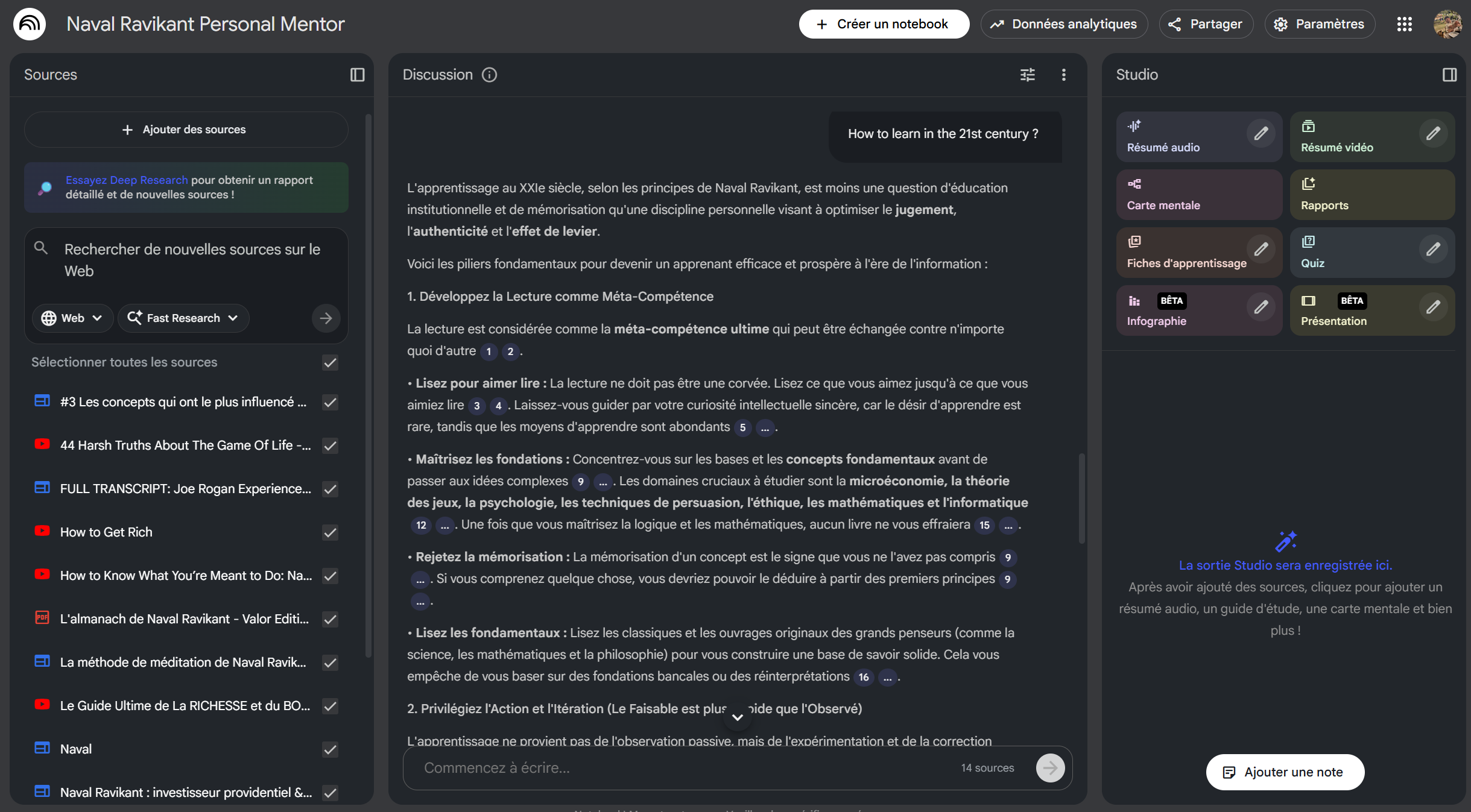
Instead of Googling "Naval Ravikant on product-market fit" and scrolling through out-of-context quotes, I ask directly:
"How should I think about product-market fit versus distribution?"
The AI synthesizes across multiple sources—his thoughts from the Tim Ferriss podcast, principles from the Almanack, nuances from lesser-known interviews. It's not perfect, but it's directionally correct and instantly available.
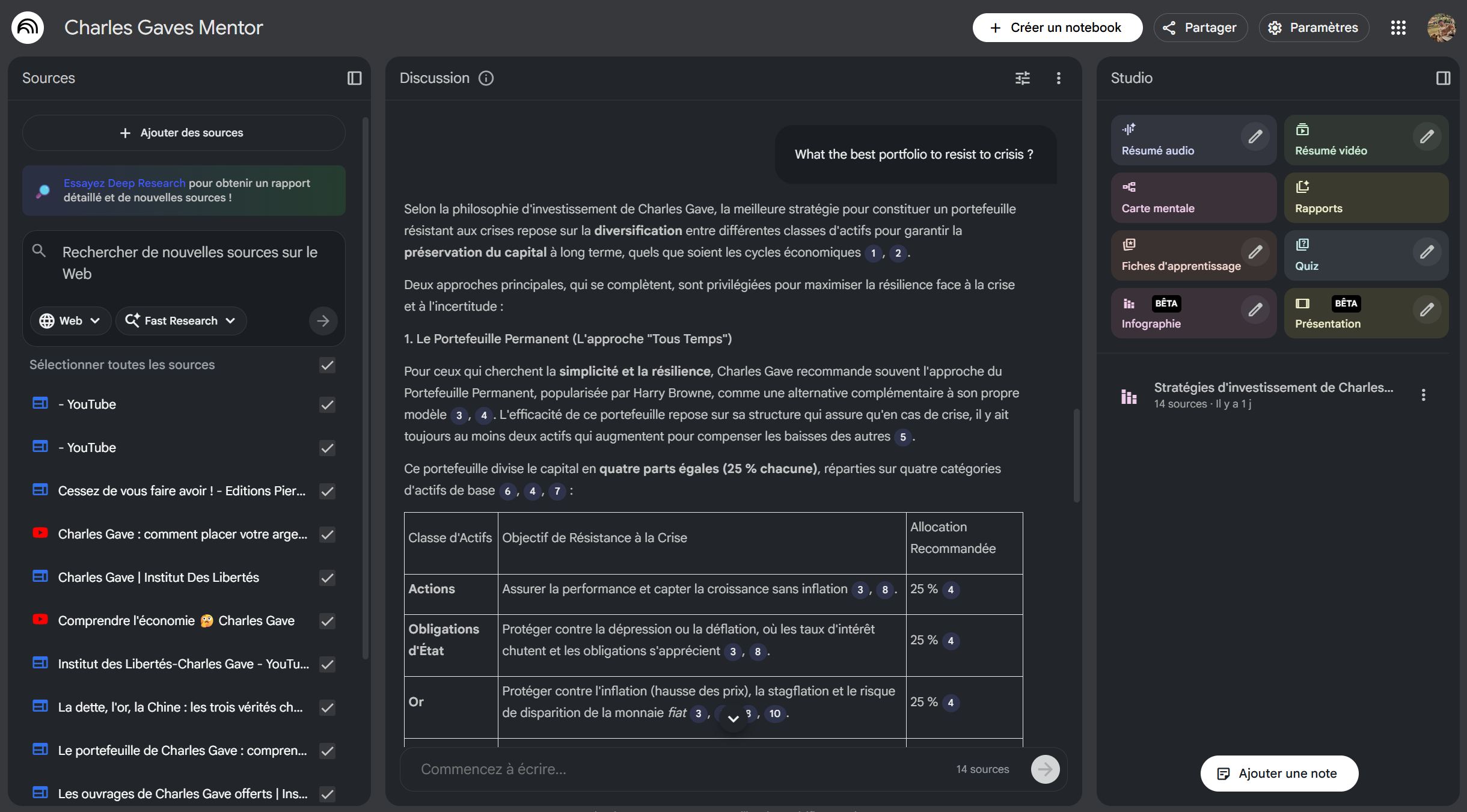
With Charles Gave, I can explore contrarian investment theses without waiting for his next publication. "What would you think about this macro setup?" gets me responses grounded in his decades of pattern recognition.
The Limitations
This isn't consciousness. It's not creativity. You're not getting new Naval Ravikant insights—you're getting better access to existing ones.
The AI can't:
- Update for new information (Naval's thinking evolves; the model doesn't)
- Push back with genuine disagreement (it pattern-matches, doesn't argue)
- Develop novel frameworks (it remixes, doesn't create)
Use this for retrieval and synthesis, not innovation.
Why This Matters
We're entering an era where anyone can have conversational access to the world's best thinking. Not through expensive courses or gatekept communities—through publicly available knowledge, properly organized.
The bottleneck is no longer access to information. It's curation and retrieval.
If you can identify whose mental models you want to internalize, you can now build your own advisory board. Naval and Charlie Munger for business thinking. Morgan Housel for financial psychology. Nassim Taleb for risk.
The technology is free. The sources are public. The only cost is the effort to gather and organize them.
How to Build Your Own
-
Choose your mentor carefully. Pick someone with substantial public output. Podcasts, books, essays, interviews—volume matters for training.
-
Gather systematically. Use transcript services for podcasts. Collect PDFs of books and essays. Compile Twitter threads. More sources = better responses.
-
Upload to NotebookLM. Create a dedicated notebook per mentor. Keep sources organized.
-
Test and refine. Ask questions you know the answer to first. Verify accuracy. Learn what types of queries work best.
-
Use it regularly. This only provides value if you actually consult it. Make it part of your decision-making process.
The Broader Implication
If you can do this with Naval and Charles Gave, you can do it with anyone who's documented their thinking publicly.
This is self-directed education at scale. No institution required. No tuition. No waiting for office hours.
The apprenticeship model of learning—sitting at the feet of masters—just became infinitely scalable.
Build your council of advisors. Make them available 24/7. Use them ruthlessly.
The technology is here. The question is: whose wisdom will you compound?
What mental models do you want instant access to? Who would be on your AI advisory board?